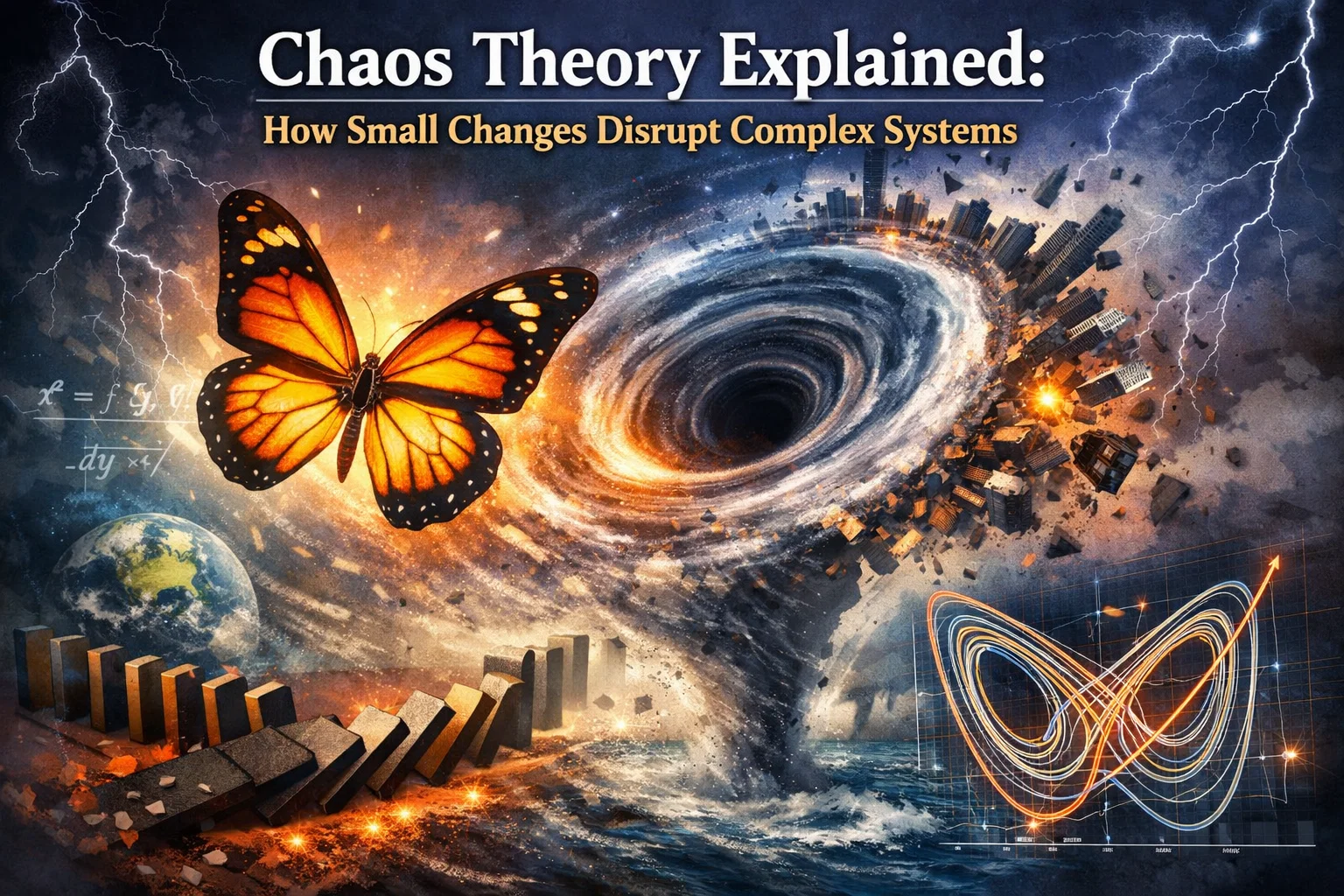

Chaos theory sounds like something abstract or highly mathematical. But the idea behind it is actually very practical—and surprisingly relatable.
It helps explain why small changes can sometimes create big effects in complex systems. And once you understand that, you start seeing chaos theory everywhere: in traffic, weather, business, ecosystems, markets, and even daily routines.
This is exactly why chaos theory matters in systems thinking.
It reminds us that not everything is predictable, even when systems follow rules. A system can be structured and still produce messy, surprising outcomes. And that insight is powerful—especially if you are trying to solve real-world problems.
Let’s break it down in a simple, practical way.
What Is Chaos Theory?
Chaos theory is the study of how complex systems behave in ways that can look random, even when they are not truly random.
That is the key point.
A chaotic system is not “disorderly” in the everyday sense. It is not pure confusion. It is usually a system with rules, patterns, and structure—but one that is very sensitive to small changes.
This sensitivity means:
-
Tiny differences at the start can lead to very different outcomes later
-
Long-term prediction becomes difficult
-
Patterns still exist, but they are harder to control
In simple words: chaos theory explains why some systems are predictable in the short term, but unpredictable in the long term.
Why the Topic Matters in Real Life
Many people assume that if we understand a system well enough, we should be able to predict it perfectly.
Chaos theory shows why that assumption often fails.
Even when:
-
We know the rules
-
We have data
-
We use good models
…the system may still behave in unexpected ways because small shifts keep getting amplified over time.
This matters in real life because most important systems are not simple:
-
Traffic systems
-
Weather systems
-
Supply chains
-
Organizations
-
Economies
-
Social systems
-
Ecosystems
These systems are connected, dynamic, and full of feedback loops. That makes them useful—but also hard to predict perfectly.
Chaos theory helps us stop expecting perfect control and start designing for resilience.
The Core Idea: Sensitive Dependence on Initial Conditions
This is the most famous concept in chaos theory.
It sounds technical, but the meaning is simple:
Small differences at the beginning can create very different results later.
Imagine two nearly identical starting points:
-
You leave home 3 minutes earlier than usual
-
You choose a slightly different route
-
One traffic light turns red instead of green
Those small differences can change your entire commute:
-
You avoid a traffic jam
-
Or you get stuck in one
-
You reach work early
-
Or arrive late and miss a meeting
Now scale that thinking up to larger systems—weather, markets, or organizations—and you can see why prediction gets complicated fast.
The system is not broken. It is just highly sensitive.
Chaos Is Not Randomness
This part is important.
People often hear “chaos” and think it means “anything can happen” or “nothing makes sense.”
That is not what chaos theory says.
A chaotic system still follows rules.
For example:
-
Weather follows physical laws
-
Traffic flows follow behavioral and infrastructure patterns
-
Businesses follow policies, incentives, and decision structures
But even when the rules are stable, the outcomes can be hard to predict over long periods.
So chaos theory sits in an interesting middle space:
-
It is not complete order
-
It is not pure randomness
-
It is structured unpredictability
That is why it is so relevant to systems thinking. Many systems we work with every day behave this way.
A Simple Everyday Example: Your Morning Commute
Let’s make this practical.
Your commute is a great example of a system that can show chaotic behavior.
It includes:
-
Road conditions
-
Traffic lights
-
Driver choices
-
Weather
-
Construction
-
Public transport timing
-
Accidents
-
School traffic
-
Delivery vehicles
You may leave at the same time every day and follow the same route. But the travel time can still vary a lot.
Why?
Because the commute system is highly interconnected and sensitive to timing.
A few small changes can cascade:
-
One car brakes suddenly
-
Cars behind slow down
-
A lane gets crowded
-
Drivers switch lanes
-
Another road gets extra load
-
A signal cycle catches more vehicles
-
The delay spreads
That traffic jam may seem to “appear from nowhere,” but in many cases it emerges from small interactions multiplying across the system.
This is chaos theory in action.
Why Prediction Becomes Difficult
You might ask: if there are patterns, why can’t we just model everything better?
Good question.
The problem is not only complexity. It is also precision.
In chaotic systems, small measurement errors grow over time.
That means:
-
If your starting data is even slightly off
-
And the system is sensitive
-
Then your long-term forecast can drift far from reality
This is one reason weather forecasts are strong in the short term but less reliable farther out.
It is not because science is weak. It is because the system is highly dynamic and sensitive.
The same idea applies in business and social systems too:
-
A small policy shift changes incentives
-
Incentives change behavior
-
Behavior changes demand
-
Demand changes operations
-
Operations change customer experience
-
Customer response changes the next cycle
Soon, the system is somewhere very different than expected.
Chaos Theory and Systems Thinking Go Together
Chaos theory becomes much more useful when we connect it to systems thinking.
Systems thinking helps us understand:
-
Relationships
-
Feedback loops
-
Delays
-
Patterns over time
-
Unintended consequences
Chaos theory adds another layer:
-
Even when we understand the system, we may still face limits to prediction
This is a healthy reminder.
It pushes us away from overconfidence.
Instead of asking:
-
“How do we control everything?”
We start asking:
-
“How do we improve outcomes in a system that is partly unpredictable?”
-
“How do we design for flexibility?”
-
“How do we reduce risk when exact forecasts are impossible?”
That shift is extremely valuable in leadership, sustainability, operations, and policy.
Feedback Loops Make Chaos More Powerful
If you work in systems thinking, you already know feedback loops matter.
In chaotic systems, feedback loops can amplify small changes quickly.
Reinforcing Loops
These amplify change.
Example in traffic:
-
Slight delay causes lane switching
-
Lane switching slows adjacent lanes
-
More drivers react
-
Congestion grows faster
Balancing Loops
These stabilize change.
Example:
-
Heavy congestion makes people delay travel
-
Traffic volume drops later
-
Roads recover
In many real systems, both loop types operate at the same time.
That is why outcomes can feel unstable one moment and self-correcting the next.
Chaos theory helps us respect this complexity instead of forcing simple explanations.
What Chaos Theory Teaches Leaders and Decision-Makers
Chaos theory is not just a scientific idea. It is also a practical mindset.
Here are a few lessons it offers:
1) Small actions can matter more than expected
Not every small change is small in impact. In sensitive systems, timing and context matter a lot.
2) Prediction has limits
Data and planning are still important—but long-term certainty is not always possible.
3) Stability can be misleading
A system may look calm until small shifts build up and trigger visible change.
4) Perfect control is unrealistic
In complex systems, trying to control every variable often creates frustration or unintended effects.
5) Resilience is better than rigid optimization
If uncertainty is unavoidable, systems should be designed to adapt, not just perform under ideal conditions.
These lessons are especially useful for businesses, public systems, and sustainability work.
Common Misunderstandings About Chaos Theory
Let’s clear up a few things.
“Chaos theory means everything is unpredictable.”
Not true. It means some systems are hard to predict long-term, especially when they are sensitive to small changes.
Short-term prediction can still be very useful.
“Chaos means no patterns exist.”
Also not true. Chaotic systems often have patterns, cycles, and structures. They just do not behave in perfectly linear ways.
“If a system is chaotic, planning is useless.”
Planning is still essential. But planning should include flexibility, monitoring, and adaptation—not just one fixed forecast.
This is where systems thinking and chaos theory work beautifully together.
How This Applies to Sustainability and Social Systems
Since you write in the systems thinking space, this connection is worth highlighting.
Many sustainability challenges have chaotic characteristics:
-
Climate and local weather interactions
-
Supply chain disruptions
-
Consumer behavior shifts
-
Policy reactions
-
Resource demand spikes
-
Ecosystem responses
A small event can trigger broader effects:
-
A heatwave increases energy demand
-
Energy systems get stressed
-
Prices rise
-
Businesses adjust operations
-
Transport and supply chains feel pressure
-
Communities face uneven impacts
This does not mean “nothing can be done.”
It means sustainability strategies should be built for uncertainty:
-
Use scenario thinking
-
Build buffers
-
Track early signals
-
Avoid single-point dependencies
-
Design adaptive policies
-
Learn continuously
Chaos theory supports a more realistic, mature approach to sustainability and systems change.
Practical Ways to Use Chaos Thinking in Daily Work
You do not need advanced math to apply the idea.
Here are simple ways to use chaos-aware thinking in your work:
1) Watch for sensitivity points
Ask: “Where do small changes create big downstream effects?”
This might be:
-
A key supplier
-
A frontline process
-
A policy rule
-
A communication delay
-
A customer response trigger
2) Avoid overconfidence in long-term forecasts
Forecasting is useful, but treat it as guidance—not certainty.
3) Build feedback loops into decision-making
Review results regularly. Learn fast. Adjust early.
4) Design for adaptability
Create systems that can respond to change, not just resist it.
5) Use scenarios instead of one prediction
Ask:
-
What if demand rises suddenly?
-
What if a delay happens?
-
What if behavior shifts?
-
What if a small disruption spreads?
This is not pessimism. It is smart systems design.
Why This Topic Matters More Than Ever
Today’s world is more connected than ever.
That means small disruptions can travel faster across systems:
-
A shipping delay affects manufacturing
-
A policy change affects pricing
-
A social trend affects demand
-
A weather event affects supply and logistics
In highly connected systems, chaos becomes more visible.
That is why leaders, consultants, and teams need a stronger systems lens. We cannot rely only on linear planning. We need to understand complexity, sensitivity, and adaptation.
Chaos theory helps us do exactly that.
It doesn’t replace planning. It improves planning.
It doesn’t reject structure. It helps us see where structure meets uncertainty.
Final Thought
Chaos theory is not about fear, confusion, or giving up on prediction.
It is about understanding reality more honestly.
It shows us that complex systems can be governed by rules and still produce surprising outcomes. It teaches us that small changes can matter, timing matters, and certainty has limits.
For systems thinkers, this is not bad news—it is useful news.
Because once we accept complexity, we make better decisions.
We plan with humility. We design for resilience. We watch feedback loops more carefully. And we stop expecting simple answers from complex systems.
So the next time your morning commute changes for no obvious reason, remember: it may not be random at all.
It may be a small example of a much bigger systems truth.