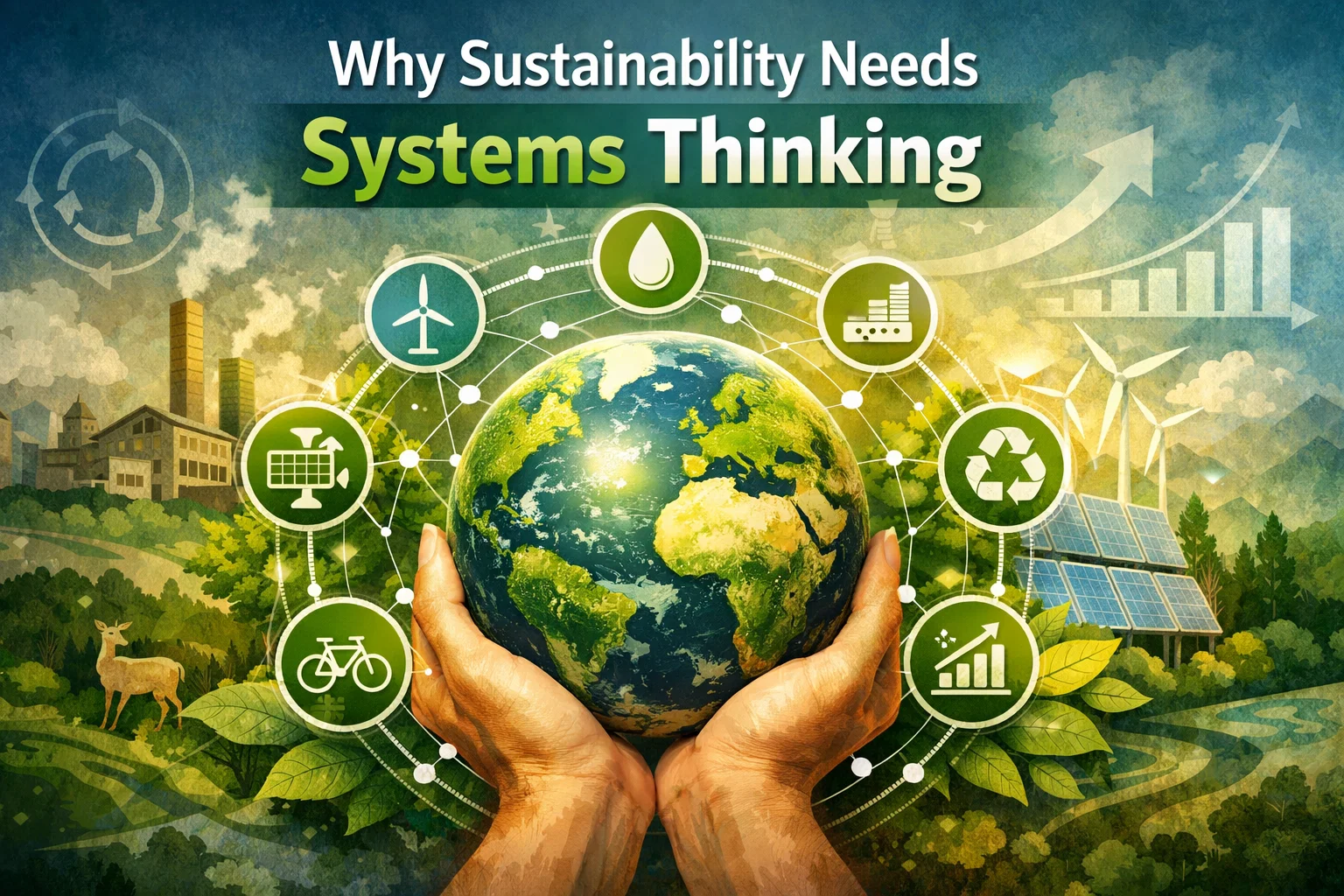

Sustainability is no longer a “nice-to-have” topic. It is now a real business, social, and environmental priority.
Organizations are trying to reduce waste. Cities are looking for cleaner energy. Communities are asking for better use of water, land, and resources. But even with good intentions, many sustainability efforts don’t create lasting change.
Why?
Because sustainability challenges are not simple. They are connected, dynamic, and often unpredictable. A solution in one area can create a problem in another. A short-term fix may look successful today but fail tomorrow.
That is why sustainability needs systems thinking.
Systems thinking helps us look beyond isolated issues and understand how things connect. It helps us see patterns, relationships, feedback loops, and unintended consequences. And most importantly, it helps us design smarter, longer-lasting solutions.
Let’s explore why this matters so much.
Sustainability Is More Than an Environmental Issue
Many people think sustainability only means protecting nature. That is part of it, but sustainability is much broader.
It includes three deeply connected areas:
-
Environmental sustainability (climate, water, air, biodiversity, waste)
-
Social sustainability (health, equity, education, community well-being)
-
Economic sustainability (jobs, livelihoods, stable growth, long-term value)
These are not separate boxes. They influence one another every day.
For example, a company may reduce costs by changing suppliers. That may help financially, but if the new supplier has poor labor practices or creates more pollution, the overall result is not sustainable.
In the same way, a city may promote electric vehicles to reduce emissions, but if the electricity comes from fossil fuels and charging access is limited, the impact becomes uneven.
This is the core challenge: sustainability is a system, not a single issue.
Why Traditional Problem-Solving Often Fails
A lot of sustainability work is still done with a linear mindset:
-
Find one problem
-
Apply one solution
-
Expect one result
That approach works for simple problems, but sustainability problems are usually complex.
They involve multiple stakeholders, delayed outcomes, competing goals, and changing conditions. In systems thinking, these are often called complex or wicked problems.
Take plastic waste as an example.
A common response is to ban plastic bags. That can help, but the system does not stop there. New questions appear:
-
What alternatives will people use?
-
Are those alternatives affordable?
-
Are they truly lower-impact?
-
Does the city have waste systems to support them?
-
Are businesses shifting to other harmful packaging?
The issue is not that plastic bans are wrong. The issue is that one policy alone rarely solves the full problem.
Without systems thinking, we treat symptoms and miss the structure causing the problem.
Systems Thinking Helps Us See the Bigger Picture
Systems thinking is a way of understanding how parts of a system interact over time.
Instead of asking only, “What is the problem?” it asks:
-
What is this problem connected to?
-
What patterns are repeating?
-
Who is influencing the outcome?
-
What happens if we change one part?
-
What side effects might appear later?
This way of thinking is especially useful in sustainability because most sustainability challenges are driven by relationships, not single events.
For example, rising energy use in a city may be linked to urban design, transport systems, housing quality, income levels, and behavior. If we only focus on one piece, we may miss where the real leverage is.
Systems thinking helps us move from quick fixes to deeper understanding.
Sustainability Problems Are Interconnected
One of the strongest reasons sustainability needs systems thinking is interdependence.
Everything is connected.
A simple example is the relationship between water, food, and energy:
-
Agriculture needs water
-
Water systems need energy for pumping and treatment
-
Energy production often needs water
-
Food transport depends on fuel and infrastructure
-
Climate patterns affect all three
Now imagine a region facing water shortages.
If leaders focus only on water supply, they may increase energy use. If they focus only on crop production, they may drain groundwater. If they focus only on energy expansion, they may create new pressure on land or rivers.
Systems thinking helps decision-makers look at the full picture, not just one department’s target.
This doesn’t make decisions harder—it makes them smarter.
It Prevents Unintended Consequences
Many sustainability efforts fail because they ignore how people and systems respond to change.
A solution may be technically correct but still underperform because behavior changes.
For example, a company installs energy-efficient equipment to reduce electricity use. The technology works. But employees become less careful because they assume the new system uses “very little energy anyway.”
This is a common pattern called the rebound effect.
The intended benefit still exists, but it becomes smaller than expected.
Systems thinking helps us plan for these reactions. It encourages us to ask:
-
How will people behave after this change?
-
What incentives are shaping decisions?
-
What hidden pressures may reduce impact?
Sustainability is not just about technology. It is about human behavior, policy, culture, infrastructure, and economics—all interacting at once.
Feedback Loops Drive Sustainability Outcomes
One of the most useful systems thinking concepts in sustainability is the feedback loop.
A feedback loop is when actions create results that influence future actions.
There are two important types:
1) Reinforcing Loops
These create growth or decline over time.
Example:
-
Deforestation reduces soil quality
-
Poor soil lowers crop yields
-
Low yields increase pressure to clear more land
-
More deforestation follows
This creates a harmful cycle.
But reinforcing loops can also be positive:
-
More people use public transport
-
Transit systems get more investment
-
Service improves
-
Even more people use public transport
2) Balancing Loops
These help stabilize systems.
Example:
-
Water use rises during drought
-
Restrictions are introduced
-
Consumption drops
-
Supply pressure reduces
If we ignore feedback loops, sustainability actions may seem random. If we understand them, we can identify what is driving the system and where to intervene.
Sustainability Requires Long-Term Thinking
Another reason systems thinking is essential is time.
Sustainability outcomes often involve delays.
-
Reforestation takes years to restore ecosystems
-
Education campaigns take time to shift behavior
-
New regulations may take months or years to show full impact
-
Climate actions today may not show visible benefits immediately
Without systems thinking, teams often become frustrated. They try something, don’t see fast results, and move on too quickly.
Systems thinking teaches us to expect delays and design for them.
It helps organizations track early indicators, stay committed to long-term goals, and avoid the trap of chasing only short-term wins.
This is especially important in business settings where quarterly pressure can push leaders to choose visible results over meaningful change.
It Helps Us Find Better Leverage Points
Not all actions in a system have the same impact.
Some changes produce small improvements. Others reshape the system.
Systems thinking helps us identify leverage points—places where a smart intervention can create large and lasting effects.
Imagine a city trying to reduce landfill waste.
A basic response is to add more bins. That may help, but the impact could remain limited.
A systems thinking approach might reveal stronger leverage points, such as:
-
Packaging standards for businesses
-
Incentives for refill and reuse models
-
Better sorting infrastructure
-
Public education linked to local habits
-
Pricing signals for disposal
-
Partnerships for circular product design
These interventions change the structure of the system, not just the surface behavior.
That is a major shift. Instead of doing “more activity,” systems thinking helps us do the right activity.
Sustainability Needs Collaboration Across Silos
Sustainability cannot be solved by one team alone.
In organizations, sustainability touches:
-
Procurement
-
Operations
-
Finance
-
HR
-
Compliance
-
Marketing
-
Leadership
In cities, it involves:
-
Government
-
Businesses
-
Communities
-
Utilities
-
Transport authorities
-
Schools
-
Civil society
Each group sees part of the system. Very few see the whole.
Systems thinking helps build a shared understanding. It creates a common language for discussing trade-offs, dependencies, and long-term impacts.
For example, a procurement team may choose cheaper materials to cut costs. Operations may prioritize speed. Sustainability teams may focus on emissions. Finance may focus on margins.
None of these priorities are wrong—but if they are not aligned, the system pulls in different directions.
Systems thinking helps teams ask:
-
What is our shared purpose?
-
Where are our goals conflicting?
-
What decisions create hidden costs elsewhere?
-
How can we design solutions that support multiple goals?
This is where sustainability becomes strategic, not just operational.
It Supports Circular and Regenerative Thinking
Many systems still operate in a linear way:
Take → Make → Use → Dispose
This model creates waste and resource pressure.
Sustainability calls for more circular and regenerative systems:
Design → Use → Recover → Reuse/Regenerate
But circularity is not achieved by one action, like recycling labels. It depends on the full system:
-
Product design
-
Material choices
-
Consumer behavior
-
Collection systems
-
Repair options
-
Reverse logistics
-
Market incentives
-
Policy support
A product may be “recyclable” on paper, but if local systems cannot collect or process it, the circular loop breaks.
Systems thinking helps us connect these pieces so sustainability efforts work in practice, not just in reports.
Practical Ways to Apply Systems Thinking in Sustainability
You do not need complex software models to begin. Teams can start with simple habits.
1) Map the system
Before launching a solution, map the actors, flows, decisions, and pressures involved.
2) Look for recurring patterns
Ask: “What keeps happening?” not just “What happened this time?”
3) Include different perspectives
Talk to people across departments, communities, and stakeholder groups. Hidden insights often come from the edges.
4) Plan for delays
Define short-, medium-, and long-term indicators so teams do not give up too early.
5) Test for unintended effects
Before acting, ask: “What might this improve—and what might it worsen?”
6) Focus on root causes
If a problem keeps returning, the system structure may need to change.
7) Find leverage points
Prioritize interventions that shift incentives, information flows, and system design.
These practices can improve sustainability efforts in companies, nonprofits, governments, and local communities.
Final Thought
Sustainability is not just a technical challenge. It is a systems challenge.
We already have many tools, technologies, and ideas. What we often need is a better way to connect them.
That is why systems thinking is so important.
It helps us understand complexity, reduce unintended harm, align stakeholders, and build solutions that last. It pushes us beyond short-term fixes and toward resilient, long-term change.
If sustainability is the destination, systems thinking is the mindset that helps us get there—wisely and effectively.
Start small. Map one issue. Ask better questions. Look for patterns.
That is where real sustainability work begins.