

A service times out. The caller retries. The retry adds load to a dependency already running hot, which slows further, causing more timeouts across the services that depend on it. A local defect has become a system event. Cascading failures occur when disturbances propagate through dependencies and feedback, making the impact larger than the initiating fault.
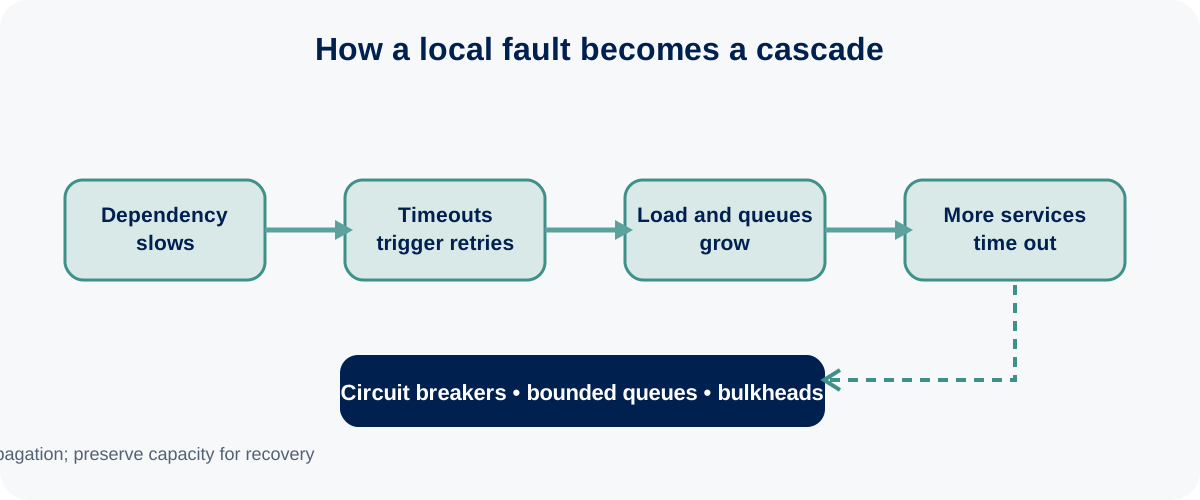
The systems thinking question is not simply which component broke. It is what connections, incentives, and control mechanisms allowed a disturbance to travel and grow. Fixing the first visible error may restore one component while leaving the propagation path intact.
How a local fault becomes a cascade
Distributed services depend on databases, identity providers, DNS, queues, network links, deployment systems, and external APIs. A dependency may be logically separate but operationally coupled through a common region, credential service, control plane, or capacity pool. When one dependency slows, callers hold threads or connections while waiting. Queues grow; memory and worker capacity become scarce. Health checks may mark instances unhealthy, reducing capacity as demand peaks.
Retries can create a reinforcing loop: failures trigger retries; retries increase load; load raises latency; latency creates more timeouts and retries. Exponential backoff with jitter, retry budgets, and idempotency controls can reduce synchronized and duplicate work, but retries do not replace capacity or graceful degradation.
Shared infrastructure creates another route. A configuration rollout, certificate expiration, bad deployment, or control-plane failure can affect many services at once. The 2024 CrowdStrike incident illustrated how a faulty content update to a widely used endpoint product could cause broad Windows outages, as detailed in the company’s preliminary post-incident review. AWS’s own December 2021 US-EAST-1 post-event summary likewise shows why region, service, and control-plane boundaries matter. The events differ; the lesson is to map common dependencies and blast radius rather than assume organizational ownership means technical independence.
Map the propagation paths
Build a dependency graph that includes synchronous calls, asynchronous queues, shared data stores, deployment systems, identity, and external providers. Record failure behavior: timeout, retry policy, queue limit, circuit breaker, fallback, and owner. A graph that says only “A calls B” misses the conditions that determine whether failure spreads.
Find where delays accumulate. A request may wait at a gateway, application pool, queue, database lock, or downstream API. Each wait consumes finite resources. Measure queue depth and age, saturation, error rate, and tail latency, not only averages. A service can report acceptable average latency while a growing tail exhausts caller timeouts.
Use incident timelines to identify feedback. Did timeouts trigger retries? Did autoscaling add instances that increased pressure on a shared database? Did health checks remove capacity? Treat these as properties to redesign, not proof that one operator caused the incident.
Contain failures with explicit boundaries
A circuit breaker stops a caller from repeatedly invoking a dependency after failures. AWS Prescriptive Guidance describes closed, open, and half-open states: normal calls, paused calls, and cautious recovery probes. This limits the caller’s contribution to a cascade. Thresholds and fallback behavior matter; an overly sensitive breaker can create a second outage.
Bulkheads isolate resource pools so one slow dependency cannot consume every worker or connection. Set timeouts within the end-to-end latency budget. Bound queues and reject excess work deliberately instead of allowing unbounded waiting. Shed optional work and serve cached or reduced-function responses where correctness permits. Keep control-plane operations available when data-plane work is overloaded.
Design retries as one end-to-end policy. If every layer retries independently, one user action can multiply into many downstream calls. Assign retry ownership, cap attempts, use jitter, and retry only operations safe to repeat. For side effects, idempotency keys help prevent a retry from charging twice or creating duplicate jobs.
Practice recovery, not just prevention
Resilience means the ability to absorb, adapt, and recover, not a promise that components never fail. Run controlled exercises with latency, dependency loss, exhausted pools, and bad configuration. Verify that alerts reveal user impact, responders can stop a rollout, and recovery procedures work without the failing dependency.
After an incident, record the initiating fault, propagation mechanisms, detection gaps, and actions that changed the trajectory. Track time to detect and restore, affected services, queue recovery, and whether safeguards constrained blast radius. Improve the system and the organization operating it.
Review checklist
- Which dependencies are shared across nominally separate services?
- Can retries, queues, or health checks amplify overload?
- Are timeouts, concurrency limits, and retry budgets defined end to end?
- Can optional features degrade without taking the core workflow down?
- Have recovery paths been exercised under realistic failure conditions?
Cascades are rarely explained by one broken box. They emerge when coupling, load, and feedback align. Mapping those relationships makes the next failure less likely to become system-wide.
Explore resilience in complex systems, systems thinking in DevOps, and cybersecurity as a system.
Primary source: AWS guidance on the circuit breaker pattern.
Turn incident evidence into design changes
During an outage, responders need to separate the trigger from the amplifiers. A trigger might be a failed certificate rotation or a database node running out of disk. Amplifiers may include a retry storm, synchronized health checks, a queue with no admission limit, or an autoscaler that launches workers faster than the database can accept connections. The incident report should identify both. Otherwise a team may patch the trigger and leave the feedback that turned it into a cascade.
Build the timeline from telemetry that crosses service boundaries. Align clocks, request IDs, deployment events, queue metrics, and provider status. Look at the first abnormal signal and how it moves: latency, saturation, retries, and customer-visible failures. Preserve uncertainty where telemetry is incomplete. An incident review is a model of what happened and should be updated when new evidence appears.
For each proposed safeguard, state the mechanism it changes. A concurrency cap limits the number of requests that can consume scarce workers. A queue age limit drops work that is no longer useful. A circuit breaker reduces calls to a failing dependency. A fallback keeps a narrower customer task available. This link between mechanism and evidence makes it possible to test whether the action item will actually reduce propagation.
Design recovery as a dependency too
Recovery procedures often rely on the same services that failed: identity, DNS, deployment control planes, or centralized dashboards. Document break-glass access and test it. Keep offline copies of critical runbooks and contacts. Ensure that operators can pause risky changes and restore a known configuration when primary tools are degraded.
Recovery also has feedback. Rapidly restarting every service may worsen contention or erase useful state. Throttle recovery actions, prioritize services according to customer impact, and confirm that dependencies are healthy before reopening traffic. Communicate status in plain language so users do not repeatedly retry a workflow that is still unavailable.
After a game day, compare expected and observed behavior. Did the breaker open soon enough? Did queue rejection protect the database? Did operators know which region or dependency was shared? Update architecture diagrams, alerts, and capacity assumptions based on the result. Repeating the exercise after a change turns resilience from a one-time audit into an operating habit.
Choose metrics that reveal early stress
Service dashboards should distinguish symptom, saturation, and dependency health. Latency percentiles show whether a subset of requests is waiting far longer than average. Queue age can reveal a backlog that a simple request count hides. Connection pool utilization and rejection rates show when workers are waiting on scarce downstream capacity. Correlate these signals with customer actions so responders know whether a degraded component is affecting critical journeys.
Define thresholds that lead to action. An alert that fires at a level no one can influence becomes noise. A useful signal has an owner, a runbook, and a decision attached: shed optional work, pause a rollout, reduce retries, or route around a dependency. Review alert behavior after real incidents and exercises. Thresholds that worked at last year’s traffic may be too slow when services or usage patterns change.
Separate leading indicators from availability outcomes. A service can remain “up” while its queue grows, response times worsen, and failed requests accumulate. The earlier those conditions are visible, the more options operators have to intervene. Track the time between the first abnormal signal and user impact as a measure of detection capability.
Use fault injection carefully
Controlled failure testing can reveal assumptions that ordinary monitoring misses. Begin with a limited environment and a clear hypothesis: for example, if the recommendation service is unavailable, the checkout process should still complete without personalization. Define abort conditions, inform responders, and limit the blast radius. Then inject delay, error responses, or resource pressure and observe actual system behavior.
Do not equate a successful drill with resilience. A system may pass one failure scenario but remain vulnerable to correlated failures, such as a regional outage that affects both primary and backup paths. Test dependencies and recovery procedures together, including capacity when traffic shifts. Afterward, document what the exercise did not cover and schedule follow-up work.
A resilient design makes failure states explicit. Decide which actions are safe to queue, which can be delayed, and which must fail fast. Communicate degraded behavior clearly to users and support staff. When a service cannot complete an action reliably, a clear refusal is safer than an ambiguous success that leaves data inconsistent.
Make dependencies resilient by design
Architecture reviews should ask whether a dependency is essential for every request. If a profile service is unavailable, can a cached profile support a read-only experience? If a recommendation service is slow, can the core transaction proceed without personalized suggestions? These decisions should be made with product owners because graceful degradation changes behavior. A fallback that returns stale or incomplete data can be worse than a clear error for some workflows.
Use service-level objectives to define acceptable failure budgets. When error rates or latency consume the budget, teams can pause feature launches and invest in reliability. Objectives create a feedback path between user experience and engineering priorities. They are most useful when they measure meaningful journeys rather than the health of an isolated endpoint.
Capacity planning should include failure modes. A region that takes over traffic needs enough headroom for a surge, and backup databases need realistic replication and recovery assumptions. Running every component at peak utilization leaves little room for shocks. Excess capacity has a cost, so balance it against the impact and duration of plausible outages.
Close the loop after changes
After introducing a breaker, cache, or queue limit, review whether the failure mode changed. Safeguards can introduce their own edge cases: a stale cache, a stuck open circuit, or discarded work without a clear user message. Record those effects and give operators a safe way to inspect and override behavior.
Share learning across teams that use the same platform. If one service discovers that a shared identity provider can amplify retries, other services should be able to adopt the same protection. Internal architecture forums and incident repositories can spread lessons while respecting confidentiality and avoiding blame.
Example: protect a checkout path
A retail checkout may call inventory, pricing, fraud, and payment services. If the recommendation service is slow, the system should not necessarily block a purchase. If inventory confirmation is mandatory, that dependency needs stronger isolation and clear timeouts. A causal map distinguishes essential dependencies from optional enrichment and shows where to spend reliability effort.
For each dependency, define a contract for latency, errors, and fallback. The caller should know whether a response can be cached, whether an operation can be repeated, and what customer message to show. Do not let every service independently choose long timeouts and retries; the sum can exceed the user’s patience and consume resources across the chain.
During a regional event, traffic may shift to a secondary region. That shift can reveal that the backup path was sized only for normal load. A failover plan should reserve capacity, test data consistency, and include external dependencies that remain tied to the original region. Run a controlled traffic shift before an emergency so operators learn where the real constraints are.
Make cost and risk decisions explicit
Reducing every dependency to a hard failure is expensive and can make the system less usable. Risk assessment should consider customer impact, regulatory obligations, and recovery time. A low-impact report may tolerate delay; a payment confirmation may require strong consistency. These choices belong in service design and product decisions, not only in an operations runbook.
Review failure patterns over time. A high number of small incidents may indicate a shared control weakness even if none becomes a headline outage. Track repeated alerts, temporary workarounds, and manual recovery actions. Those patterns can reveal fragility before a large failure occurs.
Coordinate incident response across teams
When a cascade crosses service boundaries, each team may see a different symptom. A shared incident commander can maintain one timeline, set priorities, and assign dependency questions while service owners diagnose their components. Keep a record of decisions and assumptions as they change. This prevents multiple teams from applying conflicting mitigations, such as one group reopening traffic while another is trying to reduce load.
Choose recovery order deliberately. Restore services that protect essential transactions and observability first, then bring optional workloads back gradually. Confirm that databases, queues, and identity providers have recovered before releasing accumulated work. Uncontrolled replay can create a second peak that re-triggers the cascade.
After service returns, communicate what is known and what remains under investigation. Customers need practical guidance, such as whether to retry a failed action or check for duplicate submissions. Support teams need a consistent explanation so they do not create more load by advising everyone to repeat requests.
