

A team misses a delivery date and responds by adding a daily status meeting. The next deadline is missed for the same reason: work enters the queue faster than the team can finish it. The meeting may improve visibility, yet the underlying planning assumption remains untouched. This is the difference between correcting an error within existing rules and asking whether the rules themselves are producing the error.
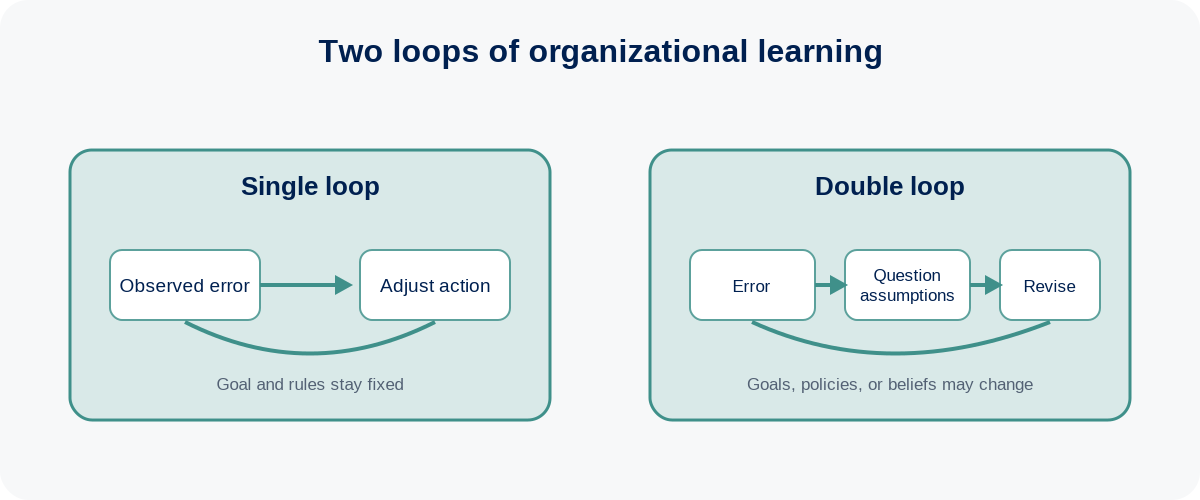
Chris Argyris called the first process single-loop learning and the deeper inquiry double-loop learning. Donald Schön developed the framework with him. The distinction is useful for organizations that repeatedly solve symptoms while preserving the policies, goals, and habits that recreate them.
Single loop and double loop
Single-loop learning compares an outcome with a target and adjusts action while keeping governing assumptions stable. A thermostat turns on heat when the room is cold. An operations team adds staff to clear a backlog. A support group updates a script after a confusing interaction. These changes can be effective when the objective and rules remain appropriate.
Double-loop learning adds a second question: should the target, rule, or assumption change? The organization may ask whether the deadline is realistic, whether the work should enter the queue at all, or whether incentives reward early commitments over reliable delivery. The “second loop” is not just a longer meeting. It changes what counts as a problem and which responses are considered legitimate.
Argyris’s 1977 account in Harvard Business Review described organizations that delayed confronting evidence that a product should be discontinued. People knew the product was failing, but norms discouraged challenging a policy senior leaders supported. The organization’s defenses protected its assumptions from information that could correct them. A feedback loop can therefore inhibit learning: the more risky it feels to report bad news, the less reliable the information leaders receive.
Why organizations stay in the first loop
People may be rewarded for meeting short-term targets, avoiding conflict, or appearing in control. If raising a concern risks blame, employees soften the message or wait for certainty. Leaders then see fragmented evidence and infer that the current strategy is working. The system reinforces silence even when individuals privately recognize the problem.
Double-loop learning is difficult because it can challenge identity and authority. A team may need to revise a long-standing measure, acknowledge that a successful practice no longer fits, or change who gets to define the goal. The work needs psychological safety, but safety alone does not ensure honest inquiry. Teams also need access to evidence, clear decision rights, and a way to test revised assumptions.
A practical inquiry cycle
- Name the mismatch. Describe the observed result and the expected result without assigning motive.
- Make the governing assumption visible. Ask what policy, metric, boundary, or belief shaped the action.
- Test the assumption. Seek disconfirming evidence, affected perspectives, and alternative explanations.
- Change a rule or goal when warranted. Make the decision explicit, including who owns it and what tradeoffs follow.
- Review the result. Observe whether the new rule changes outcomes and whether new side effects appear.
For example, if a hospital unit repeatedly discharges patients before follow-up support is ready, single-loop adjustments might add a checklist or reminders. Double-loop inquiry asks whether the discharge target, staffing model, and responsibility boundary create pressure to transfer risk downstream. The intervention may require coordination across departments rather than another form at the bedside.
Connect learning to system structure
Use a review process that separates learning from performance theater. Start with a specific event, trace how information moved, and distinguish local decisions from the constraints shaping them. Invite frontline staff and people affected by the outcome. Keep a record of assumptions that changed, not just action items assigned. Revisit those actions later to see whether they altered the system.
Do not turn double-loop learning into permanent skepticism. Some problems need a direct correction; not every incident means the organization’s purpose is wrong. The skill is knowing when repeated variance signals a deeper mismatch. Repetition, workarounds, hidden delays, and recurring unintended effects are clues that the governing design may need review.
Peter Senge’s learning organization framework offers a complementary perspective on shared vision, mental models, and team learning. Read our pages on double-loop learning in practice, mental models, and Senge’s Fifth Discipline.
Primary reference: Chris Argyris, “Double Loop Learning in Organizations”.
Make it safe to test a governing assumption
Teams cannot question assumptions that are invisible or punished. Leaders can make inquiry more concrete by asking, “What would we expect to observe if this policy were wrong?” and “Which evidence would change our decision?” Those questions invite people to offer more than agreement. They also make it possible to distinguish a genuine learning review from a meeting where the conclusion was fixed in advance.
Use small experiments when the cost of testing is manageable. If a service-level target encourages teams to close tickets prematurely, pilot a quality measure alongside closure speed. If an approval chain delays low-risk work, test a narrower delegation policy with clear limits. Define the review date and outcome measures before launching, so the team can learn from an unsuccessful change as well as a successful one.
Power differences affect whose evidence counts. Frontline employees, contractors, customers, and communities may experience effects that senior dashboards miss. Provide channels for confidential reporting and give people feedback about what changed. Otherwise the system may collect observations without closing the loop with those who supplied them.
Distinguish learning from blame
Double-loop learning is not an excuse to avoid accountability. It asks how goals and rules shaped action while still examining individual decisions. In a safety-critical setting, a person may knowingly bypass a protection; the review can address that choice and also ask why the protection was difficult to use, routinely overridden, or misaligned with production incentives. Looking at structure does not erase agency; it makes prevention more realistic.
Keep a record of the inquiry: the initial assumption, evidence considered, dissenting views, decision, and observed result. This helps future teams understand why a policy exists and when it should be revisited. It also prevents a lesson from becoming a vague poster that does not change operating behavior.
Organizations develop learning capacity through repeated practice. A short, well-facilitated review after ordinary work can be more useful than an annual transformation workshop. Over time, people learn to surface anomalies earlier, test their own explanations, and update shared rules when evidence warrants it.
Facilitate inquiry with a concrete example
Suppose a customer support organization repeatedly misses its resolution target. In the first loop, leaders may add a response template, increase coaching, or adjust shift coverage. Those actions can help if the problem is inconsistent practice or uneven demand. If the pattern persists, double-loop inquiry tests the operating assumptions: Is the target based on the actual mix of cases? Does the metric reward closing tickets before the customer’s problem is solved? Are agents allowed to coordinate with specialist teams?
Map the work from a customer’s first contact to verified resolution. Look for handoffs, re-opened cases, queue delays, and information that agents cannot access. Invite a sample of customers and frontline staff to describe where the process breaks. Then test one change, such as changing the metric to include re-open rates or giving agents authority to resolve a defined class of exceptions.
Use a short learning log with four fields: assumption tested, evidence observed, decision changed, and outcome to review. This keeps inquiry practical and helps teams avoid abstract discussion. If no assumption changed, that can still be a valid result when evidence supports the current approach.
Know when to escalate a question
Some assumptions are local; others are embedded in budgets, policy, or strategy. A team can redesign its handoff but may not be able to change the incentive structure that creates unnecessary handoffs. Establish a route for escalating structural questions with evidence and options. Senior leaders should respond visibly so people can see whether raising a systemic issue leads to action or silence.
Not every disagreement calls for double-loop intervention. Use proportionality: the more persistent, costly, or harmful the outcome, the more important it is to test the governing design. For a one-off error with a clear cause, a direct correction may be enough. For a repeated pattern, repeated local fixes can consume time while the cause remains in place.
Learning also has a social side. A revised rule may shift burdens to another team or group. Check who benefits and who absorbs new work. Include those people in the review, and monitor side effects after the change. A successful local metric can conceal worse outcomes elsewhere in the system.
Use facilitation that preserves disagreement
Facilitators can begin by asking participants to write down their explanation before the loudest voice sets the story. Compare explanations with the event timeline and available evidence. Ask what each explanation predicts and what evidence would disconfirm it. This helps teams avoid premature consensus and makes uncertainty easier to discuss.
Distinguish espoused values from values revealed by everyday practice. An organization may say it values safety while rewarding speed without regard to defects. The gap is not solved by repeating the value statement. Leaders need to examine which measures, approvals, and resource decisions reward the behavior that actually occurs.
Disagreement can be productive when it is specific and respectful. Invite people to identify the tradeoff they see, and record the evidence behind competing options. If leaders choose one path, explain why and when the decision will be revisited. People are more likely to contribute future concerns when they see that disagreement can influence a decision.
Watch for superficial adoption
Organizations sometimes adopt the language of double-loop learning while preserving their existing power structure. They ask employees to speak openly, then penalize the person who raises an inconvenient risk. They collect feedback without changing policies or explaining why no change was made. This erodes trust and makes later inquiry less likely.
To avoid this pattern, publish the questions raised, the decision owner, and the disposition of each issue. Protect confidential channels and investigate retaliation. Review whether changes reduce the original problem and whether the workload has shifted to another group. Learning is visible in changed routines and outcomes, not only in the vocabulary used during meetings.
Connect the framework to everyday management
Managers can model double-loop learning by naming their own assumptions and inviting others to challenge them. When a decision produces an unexpected result, they can ask what information they missed and whether the original success metric still makes sense. This behavior lowers the social cost of inquiry and shows that changing one’s mind is compatible with authority.
Learning requires time and resources. If teams are measured only on delivery and receive no time for reflection, the organization signals that inquiry is optional. Build brief reviews into normal workflows, fund improvement experiments, and recognize teams that surface weak signals early. Avoid rewarding only visible success stories, which can encourage people to hide uncertainty.
Use governance forums to revisit policies with evidence. A policy can include an owner, rationale, review date, and conditions that trigger reassessment. This prevents assumptions from becoming permanent simply because no one remembers why they were adopted.
Share lessons without flattening context
Reusable checklists and case studies can help teams learn from one another, but copying an intervention blindly may fail in a different context. Include the conditions that made it work, the constraints that remained, and what outcomes were measured. Encourage teams to adapt the mechanism and then evaluate their own results.
Systems thinking helps distinguish a general pattern from a local explanation. The same recurring miss may come from different structures in two departments. Let people test whether the proposed mechanism exists in their setting before applying a solution. That keeps learning transferable without turning it into a universal recipe.
Set a review rhythm for policies
Not every governing assumption can be questioned during an incident. Create a periodic forum where teams can review high-impact measures, recurring workarounds, and complaints. Bring actual cases, not only summary dashboards. Ask whether a policy still serves its purpose and who experiences its side effects. Assign an executive owner to questions that cross departments.
Keep review outcomes actionable. A decision can preserve the existing rule, revise it, or test an alternative. Record the evidence and revisit date. If leaders defer a change, state what additional evidence would resolve the issue. Clear dispositions prevent feedback from disappearing into a backlog.
