

Biology is increasingly studied as a data-rich system. Sequencing, imaging, molecular assays, and clinical records produce observations at scales that are difficult to interpret manually. Digital biology combines computational models with biological experiments to predict structures, identify targets, design candidate molecules, and decide which experiments to run next.
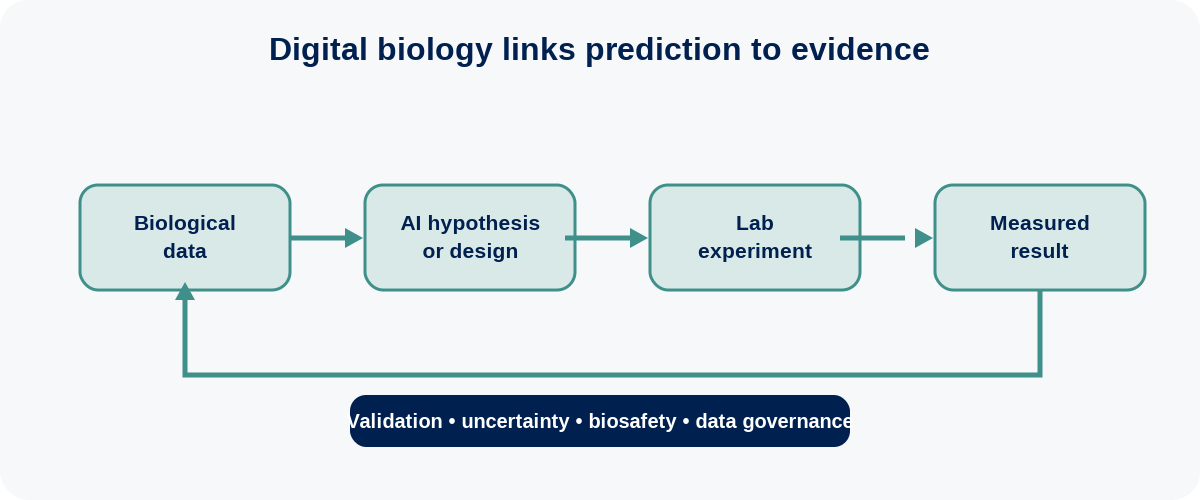
Artificial intelligence can accelerate parts of this cycle, but it does not turn a prediction into a medicine. A model output is a hypothesis about a biological system. Laboratory experiments, replication, safety assessment, and clinical evidence remain necessary to establish whether that hypothesis holds in living organisms and people.
From protein structure to molecular interactions
Proteins are chains of amino acids that fold into structures affecting their function and interactions. AlphaFold 2 made protein structure prediction far more accessible, and the AlphaFold Protein Structure Database provides predicted structures for many proteins. AlphaFold 3 extended the problem to complexes involving proteins, nucleic acids, small molecules, ions, and modified residues. Its Nature paper reports improved prediction performance for several interaction types, while also describing task-specific evaluation and limitations.
These tools help researchers form ideas about binding sites, mutations, or molecular partners. A predicted structure can guide experiments or narrow a search, but confidence measures do not establish biological activity. Protein flexibility, cellular context, concentration, post-translational modifications, and assay conditions all affect outcomes. A structure prediction should be treated as a model with uncertainty, not a photograph of a molecule in every state.
Generative design expands the search space
Protein design models can propose sequences expected to fold or perform a desired function. Researchers may specify structural constraints, a binding surface, or a target property, then synthesize and test selected candidates. The model helps search a vast sequence space that is impossible to explore exhaustively. Experimental feedback identifies what works and can improve the next design round.
Drug discovery uses related computational approaches to rank compounds, predict interactions, or generate candidates with desired properties. The practical objective is not a compelling molecule visualization. It is a candidate that can be synthesized, measured, reproduced, and developed with acceptable efficacy and safety. Early computational filters can reduce expensive lab work, yet poor data, target mismatch, and overfit benchmarks can still send teams down unproductive paths.
Build the model–experiment feedback loop
A digital biology program is strongest when computational and experimental teams share a decision loop. Define the biological question and assay before model selection. Preserve a holdout set that reflects the intended discovery task. Record sample provenance, experimental protocols, negative results, and changes in conditions. When a model fails, diagnose whether the issue came from data quality, target biology, measurement noise, or the model itself.
Beware of feedback bias. If a model suggests only candidates similar to its prior successes, experiments may reinforce a narrow region of the search space. Include diverse designs and deliberately test uncertain assumptions. Avoid reporting only successful molecules; negative results help characterize the boundaries of a model’s usefulness.
Governance and biosafety belong in the design
Biological design has potential benefits and risks. Research groups should assess how a model could be misused, who can access synthesis services, how sequences are screened, and what oversight is required for work involving pathogens or toxins. Safeguards need to evolve with model capability and local regulations. Access controls alone are not enough: institutional review, monitoring, incident response, and responsible publication decisions also matter.
Data governance is equally important. Human genomic and health data can be identifying and sensitive. Track consent, permitted uses, data retention, and access. Collaborative training may involve privacy-preserving methods, but those methods need threat modeling and validation rather than a blanket claim of anonymity.
A practical evaluation framework
- State the biological question and the experimental decision the model will inform.
- Compare predictions with appropriate baselines and independent assays.
- Report uncertainty, failure cases, and conditions under which the method was evaluated.
- Use prospective experiments to test whether predictions improve decisions.
- Apply biosafety and data-governance review before scaling access or synthesis.
Digital biology is best understood as a learning system linking data, hypotheses, experiments, and governance. AI can help researchers generate and prioritize hypotheses. Human expertise and experimental evidence determine whether those hypotheses withstand reality.
For a broader systems perspective on AI in healthcare systems and complex adaptive systems, see our related guides.
Primary references: the AlphaFold 3 paper in Nature and the AlphaFold Protein Structure Database.
Choose experiments that can disprove the model
A useful validation plan tests both a model’s likely successes and its uncertain predictions. Select candidates using predeclared criteria, retain negative results, and compare against standard computational and laboratory baselines. If every tested candidate was chosen after researchers saw the model’s score, the apparent success rate may be biased. Prospective evaluation makes the evidence stronger because the model commits to predictions before outcomes are known.
Experimental reproducibility is central. Record the sequence, construct, assay protocol, reagent batch, environmental conditions, and analysis code. A model prediction may fail because the hypothesis was wrong, or because an assay was noisy or performed differently. Shared metadata helps teams distinguish those explanations and learn across projects.
In drug discovery, computational binding predictions are only one component of a long path. Researchers still need biochemical activity, selectivity, toxicity, pharmacokinetics, manufacturability, and clinical evidence. A molecule that appears promising in a predicted pose may not bind as expected or may have undesirable effects elsewhere. Communicating these distinctions prevents a structural prediction from being mistaken for a therapeutic result.
Use systems thinking for responsible scaling
As design tools become easier to use, access and oversight become part of the technical system. Labs should define approval thresholds, screening practices, synthesis partner expectations, and procedures for reporting concerning results. Review should be proportionate to capability and context, and updated when tools or use cases change. Researchers also need support to understand model limitations rather than relying on a single confidence score.
Equity questions deserve attention. Training datasets may underrepresent organisms, populations, or experimental conditions. A model that performs well on common targets can fail where data are scarce. Track performance across relevant groups and research settings, and invest in data quality rather than assuming scale alone produces coverage.
Distinguish prediction from design
Protein structure prediction estimates a plausible arrangement for a sequence or molecular complex. Protein design searches for a sequence likely to adopt a desired structure or function. Drug discovery involves additional questions about binding, selectivity, safety, exposure, and efficacy. These tasks are related, but a strong result in one does not establish success in the next.
When reading a paper or product claim, inspect the evaluation set and comparison baseline. Was the target similar to examples in training? Were predictions compared against experimental structures or only other model outputs? Did the evaluation test the final experimental objective? Confidence metrics can help prioritize experiments but should not be interpreted as a probability that a candidate will become a useful therapy unless calibrated for that outcome.
Researchers can improve the loop by selecting experiments that are informative, not only those most likely to succeed. A candidate that tests a model’s uncertain region may teach more than another example near a known pattern. Active learning can help prioritize these experiments, but the strategy must consider assay cost, biological relevance, and the value of negative results.
Account for intellectual property and access
Digital biology depends on data and tools that may have distinct licenses and usage terms. Confirm whether structures, sequences, training data, and software can be used for commercial or clinical research. Document attribution and restrictions. For collaborators, agree on data access, publication, benefit sharing, and ownership before exchanging sensitive materials.
Access differences can affect which diseases and populations receive research attention. Projects with abundant public data may advance faster than conditions underrepresented in existing datasets. Partnerships with clinical institutions and affected communities can improve relevance, while governance must protect privacy and prevent extractive use of biological information.
These practices do not slow scientific progress for its own sake. Clear provenance and permissions help downstream teams trust and reproduce results. Responsible collaboration is part of the technical infrastructure needed to translate computational predictions into credible evidence.
What success looks like beyond a model score
For a research team, success may mean fewer experiments needed to identify a binding candidate, a broader range of targets that can be studied, or a more reproducible workflow. For a drug-development program, a higher structure prediction score is not enough. Measure whether candidates advance through assays, whether results replicate across laboratories, and whether the model improves a decision relative to existing methods.
Track the denominator. A paper may showcase a handful of successful designs, while the program produced many failed candidates. Reporting the number synthesized and tested, the selection rule, and the proportion that met predeclared criteria helps other teams understand the practical yield. It also protects against publication bias that can make tools appear more reliable than they are.
External validation is important when a model is intended for a new organism, assay, or population. Partner with domain experts who can identify biological assumptions that are invisible in the training data. A model can generalize statistically while failing to represent the causal mechanism that researchers care about.
Keep humans accountable for decisions
AI can prioritize candidate experiments, but scientists remain responsible for design, interpretation, and safety. Record which decisions were model-assisted and how evidence was weighed. Establish review thresholds for high-risk research and procedures for escalating unexpected findings. This makes the workflow auditable and supports learning when the model’s role changes.
Digital biology will advance through a combination of tools, experiments, institutions, and public trust. The most valuable systems are those that make research more informative while preserving transparency about uncertainty and consequences.
Bring domain expertise into model evaluation
Biologists can identify whether a proposed structure is plausible in the context of cellular localization, binding partners, or known mechanisms. Chemists and pharmacologists can assess whether candidate molecules are synthetically accessible and likely to survive assays. Data scientists can analyze leakage and calibration. An interdisciplinary evaluation avoids over-relying on a metric owned by one team.
Reviewers should know how candidates were selected and whether the model’s confidence estimate influenced which examples were tested. Blinding can reduce expectation effects. Pre-registering the main evaluation criteria helps ensure that success is not redefined after results arrive. For expensive experiments, explain how resource constraints affected the sample and what conclusions remain uncertain.
When research is intended to support clinical decisions, standards for evidence and oversight are higher. Validate the workflow on external data, monitor performance after deployment, and preserve human review. A model used to prioritize laboratory research has a different risk profile from a tool that directly informs care.
Communicate limitations clearly
Researchers should describe what a model was trained to do, which data were evaluated, and what kinds of outputs are unsupported. Avoid wording that implies a candidate has been “designed” for a function when only a sequence or structure hypothesis exists. Explain that a predicted complex may not reflect dynamics or physiological conditions.
Clear communication helps investors, patients, policymakers, and the public distinguish scientific progress from clinical readiness. It also protects the credibility of digital biology as a field. Ambitious goals are appropriate when accompanied by evidence boundaries and plans for validation.
Plan experiments around uncertainty and cost
Laboratory capacity is finite, and experiments differ in cost, speed, and information value. A model can help rank candidates, but the best next experiment may be one that distinguishes between competing mechanisms rather than one with the highest predicted score. Researchers can combine active learning with domain judgment to choose tests that reduce uncertainty and avoid repeated low-information assays.
Predefine the primary measurement and handling of failed or ambiguous results. Assay thresholds, normalization choices, and exclusion criteria can change apparent performance. If multiple candidate designs are tested, adjust interpretation for the number of comparisons and avoid selecting only the best-looking result after the fact. Independent replication helps determine whether the signal is robust.
Negative outcomes should be preserved in internal datasets and, when appropriate, shared with the research community. They can reveal where a generative design system extrapolates poorly or where a biological target is less tractable than expected. If only successful examples are fed back into the next model, the data loop can become overconfident and narrow the search.
Align development with the right evidence
Different stages require different evidence. Early discovery can use computational ranking and exploratory assays. A preclinical candidate requires broader safety and pharmacology work. Clinical claims require controlled studies and regulatory review. Describe each result according to its stage. Avoid implying that an AI-designed molecule has therapeutic efficacy because it was generated computationally or showed activity in one assay.
For public datasets, document versioning and provenance. Protein sequences and structures may be updated as annotations improve. Record which release supported an analysis so later researchers can reproduce the comparison. The AlphaFold database notes data updates and expects attribution; citation and version tracking help maintain a reliable research trail.
