

Modern software is assembled from code written by many teams, package registries, build services, container images, and deployment tools. That creates a supply chain: a change or compromise at one point can reach thousands of downstream users. The SolarWinds incident made this risk visible, but the underlying problem is broader than one vendor or one attack. CISA’s joint advisory on the compromise documents the campaign and response. Organizations often cannot quickly answer what went into a release, where it was built, and which deployed systems contain an affected component.
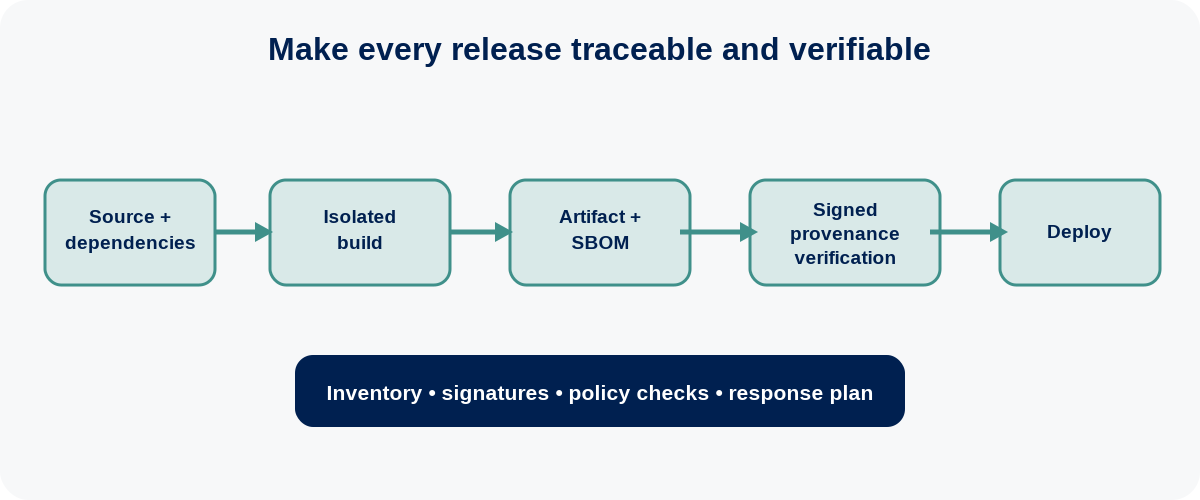
Software supply chain security combines inventory, provenance, integrity checks, access control, vulnerability response, and recovery. No single artifact guarantees safety. A software bill of materials (SBOM) and SLSA build provenance answer different questions and work best as part of an operational process.
What an SBOM tells you
An SBOM is a machine-readable inventory of software components and relationships in a product. It can help teams identify whether a known vulnerable library appears in an application and which services may need review. Formats such as SPDX and CycloneDX support automated exchange. An SBOM is only useful when it is accurate, tied to a specific artifact, updated for each release, and connected to asset inventory.
Inventory is not the same as assurance. An SBOM does not prove a dependency is safe, that the build used the listed source, or that a package was not modified. It can be incomplete when build tooling misses transitive dependencies, vendored code, plugins, or runtime-loaded components. Track provenance and verify artifacts separately.
What SLSA adds
SLSA is a specification for describing and improving supply chain security. Its build track focuses on how an artifact was produced and the integrity of its provenance. Provenance records the builder, inputs, and process. Higher levels add stronger protections against tampering during or after a build. SLSA is not a blanket certification that an application has no vulnerabilities; it gives consumers evidence to compare with their expectations.
For each release, generate provenance from the build service and bind it to the artifact’s cryptographic digest. Store signed attestations alongside the release. At deployment, verify the signature, builder identity, repository and workflow, source revision, and policy requirements. A signed statement that does not match the exact deployed bytes is not sufficient.
Reduce the attack surface across the chain
Protect source repositories with multifactor authentication, least-privilege tokens, branch protections, and review requirements. Pin dependencies where practical, monitor maintainers and package changes, and prefer reproducible, reviewed build inputs. Isolate build jobs, restrict network access, and avoid long-lived secrets. Sign releases through controlled services rather than developer workstations.
Build systems are privileged infrastructure. Separate duties, log administrative actions, monitor unusual pipeline changes, and test recovery from compromised credentials. Keep an inventory of critical builders and registries. Establish a process for revoking a release, publishing a corrected artifact, and identifying downstream consumers.
Prepare for vulnerabilities and compromise
SBOM data can support vulnerability triage, but teams need a response workflow. When a vulnerability is announced, identify affected artifacts by digest, map them to production services, assess exploitability and exposure, and prioritize mitigations. A component’s presence is a signal to investigate, not proof that the vulnerability is exploitable in your configuration.
Run tabletop exercises that assume a signing key, package maintainer account, or CI runner is compromised. Can you stop releases, rotate trust roots, rebuild from known inputs, and tell customers which versions are affected? Keep emergency changes reviewable and preserve evidence for later analysis.
Implementation sequence
- Generate an SBOM for every release and connect artifacts to deployed assets.
- Harden source control, build identities, runners, and secret handling.
- Create signed provenance and verify it against explicit policy at release or deployment.
- Automate vulnerability triage while retaining human risk assessment.
- Practice revocation, rebuild, rollback, and customer communication.
Start with the most consequential services and improve coverage incrementally. Supply chain security is a feedback system: inventory reveals exposures, verification catches unexpected build paths, and incident learning updates policy. The objective is not paperwork volume. It is being able to detect, constrain, and recover from compromise.
For related operational context, read about cybersecurity across an attack surface, shared open-source dependency risks, and DevOps and software systems. The planned Open Source page is unavailable; the linked article is the closest published discussion of shared resources.
Primary references: the SLSA v1.2 specification and CISA’s SBOM resources.
Use evidence that downstream teams can verify
For a software artifact, provenance should identify the exact digest, builder, source revision, and build process in a verifiable format. Consumers need a policy that states which builders and workflows they trust. Verification can happen at release intake, artifact promotion, or deployment, but it should be close enough to use that an unexpected build does not reach production unnoticed.
SBOM quality needs routine review. Compare generated inventories with package manifests and runtime observations. Record how the SBOM was produced and which components may be missing. When a vulnerability appears, map affected versions to actual deployment records and determine whether the vulnerable code path is reachable. This supports prioritization without treating every alert as equally urgent.
Open-source maintainers often work with limited resources. Organizations that depend on critical packages can contribute funding, security review, and maintenance rather than treating upstream projects as free infrastructure. A healthier ecosystem improves the reliability of the supply chain for everyone.
Make recovery measurable
Track how long it takes to identify affected releases, block vulnerable packages, rotate compromised credentials, and deliver a corrected build. Test whether archived artifacts can be traced to source and whether signatures can be revoked without breaking every deployment. Document who can authorize emergency exceptions and how those exceptions expire.
Security teams should coordinate with developers and procurement. Contract language can request SBOMs and provenance, but technical validation still matters. Ask vendors how they generate the inventory, how frequently it changes, and how customers receive urgent notices. Verify these commitments through samples and incident exercises.
Coordinate response across organizational boundaries
Supply chain incidents cross procurement, engineering, security, legal, and communications. Decide ahead of time who can quarantine a package, pause a release, contact a vendor, and notify customers. A technical inventory without decision rights can leave teams waiting during the period when compromise is spreading.
Set expectations with suppliers around notification times, supported versions, artifact retention, and evidence formats. Ask how they secure build identities and how they respond when a signing key is exposed. For critical suppliers, rehearse a scenario where their release must be blocked quickly. These discussions are more useful before an incident than during a negotiation under pressure.
Communicate uncertainty responsibly. Early incident information is often incomplete. State what is confirmed, which versions may be affected, what mitigations are available, and when the next update will arrive. Avoid declaring systems safe simply because no compromise has yet been observed.
Prioritize improvements by risk
Start with software that has broad reach, privileged access, or high impact if unavailable. Map the most important build pipelines and identities. Protect signing keys and production credentials first, then expand SBOM and provenance coverage. This staged approach builds reliable practice rather than collecting incomplete inventories across every low-risk service.
Measure progress through verifiable behaviors: proportion of releases with complete SBOMs, deployments rejecting invalid provenance, time to locate affected artifacts, and time to rotate compromised credentials. These measures indicate whether a team can act on evidence. They do not prove that all supply chain attacks are prevented, so pair them with threat modeling and incident exercises.
Open-source projects are part of many commercial products. Long-term security improves when organizations contribute resources to dependencies they rely on. Funding maintenance, participating in security reviews, and reporting vulnerabilities responsibly reduce the chance that critical components remain under-resourced.
SBOM and provenance are useful together
Consider a vulnerability announced in a popular library. The SBOM helps identify artifacts that include the library; deployment inventory shows where those artifacts run; provenance points to the source revision and builder that produced them. Together, these records help answer who is affected and whether a package came from an expected process. Without deployment mapping, a complete inventory may still leave responders unsure where to act.
Automate the connection among artifact digest, SBOM, provenance, and deployment record. A component name alone can be ambiguous because forks, patched versions, and vendored copies may differ. Use package URLs and cryptographic digests where available, and retain historical inventories for supported releases. Confirm that generated data matches the artifact users actually receive.
When evaluating a security tool, test its ability to represent container layers, operating system packages, application dependencies, and build-time tools. No scanner sees every dependency equally well. Document blind spots and use multiple sources when the risk justifies it.
Build a culture of secure contribution
Security practices should be usable by developers. Provide standard pipeline templates, protected runners, dependency update tooling, and clear exceptions processes. If controls are too cumbersome, teams may bypass them under delivery pressure. Measure friction and improve defaults while keeping the most sensitive privileges restricted.
Organizations can contribute fixes upstream and help maintainers respond to vulnerabilities. Coordinate disclosure privately, fund security work, and avoid publishing exploit details before users can patch where responsible. The health of the supply chain depends on relationships and incentives as well as cryptographic controls.
Understand the limits of standardized frameworks
A framework gives teams a shared vocabulary and baseline, but it does not eliminate the need for a threat model. An attacker may target source control, a package maintainer, a cloud identity, a build runner, a signing service, or a distribution channel. Controls should correspond to the paths that matter for the organization’s software and adversaries.
Higher assurance can require platform changes, additional cost, or slower build workflows. Prioritize the systems whose compromise would have the greatest reach or privilege. For a small internal tool, an SBOM and protected pipeline may provide good initial value. For widely distributed or critical software, signed provenance and deployment verification may be necessary. Document accepted residual risk.
Framework versions evolve. Pin the version used in policy and review it periodically. Avoid comparing “SLSA level” claims without checking which track and version they refer to. A named level is meaningful only when the artifact, builder, and required properties are clear.
Respond when provenance is missing
Missing provenance does not automatically prove compromise, but it removes evidence that a build followed an expected process. Define what happens: hold the artifact for review, rebuild from trusted source, request evidence from a supplier, or accept a time-limited exception. Record the decision owner and expiration so exceptions do not become permanent.
When provenance verification fails, preserve the artifact and logs for investigation. Do not overwrite evidence with an emergency rebuild. The response team may need to compare the suspicious package with source, builder records, and known-good releases to determine the scope.
Integrate SBOMs into vulnerability operations
An SBOM should connect to a live inventory of what is actually deployed. At build time, attach it to the artifact digest and release identifier. At deployment, record that identifier against the service, environment, and owner. When a vulnerability appears, responders can move from component name to affected artifact to production instance without manually searching unrelated spreadsheets.
Define an update cadence. Generate a new SBOM for each build or meaningful change, preserve older versions for supported releases, and correct known errors promptly. CISA’s minimum-elements guidance emphasizes component coverage, including transitive dependencies, and the need to identify known unknowns. A recipient should not assume an omitted component is absent when the inventory is incomplete.
Use automated feeds carefully. Vulnerability databases may contain duplicates, disputed severity, or ecosystem-specific version semantics. A triage record should note the affected package, reachable code path, exposure, available mitigation, and decision owner. Prioritize active exploitation and critical services while preserving a route for overlooked issues to be escalated.
Verify the release path, not just the package
Attackers can compromise a legitimate dependency, inject code into a build, steal a signing key, or tamper with an artifact after compilation. Protecting only the source repository leaves several gaps. Provenance and signed artifacts help connect the deployed bytes to a builder and source revision. Verification should enforce a policy that rejects unexpected builders or unreviewed branches.
Separate credentials by job and scope. Short-lived identities reduce the value of a stolen token. Build runners should start clean, receive only required secrets, and avoid unrestricted network access. Preserve logs and attestations long enough to support investigations, while limiting access to sensitive build data.
Practice a supplier compromise scenario
Run a tabletop exercise where a widely used package is maliciously updated. Ask how quickly the team can identify the package in supported releases, stop new builds, determine whether the code ran in production, and notify affected customers. Include procurement and communications so technical evidence can be translated into a clear response. Record the time needed for each action and improve the slowest handoff.
